Forskning
DSA har utvecklats som en metod för psykoterapins processforskning. Föreningens medlemmar bedriver aktiv forskning med hjälp av DSA.
Klinisk forskning
Effektiviteten av DiaSek®-metoden har studerats i en randomiserad klinisk studie vid Päijät-Häme centralsjukhus psykiatriska klinik åren 2015–2016. Studien jämförde DiaSek®-bedömning med konventionell psykiatrisk bedömning, med 40 patienter i vardera gruppen.
DiaSek® visade sig vara betydligt mer klientcentrerad: överensstämmelsen mellan patient och bedömare gällande vårdmål, metoder och samarbetskvalitet var 0,63 (Spearmans Rho), jämfört med 0,26 i konventionell bedömning.
Resultaten har publicerats i European Journal of Mental Health.
Från och med 2015 har ett tvåårigt utvecklingsutbildningsprogram genomförts i samarbete med Nuorten Ystävät rf och Uleåborgs universitet, med tillämpning av DiaSek® inom ungdomsarbete.
DSA-Intelligence
Ett forskningsprojekt som utvecklar AI-baserade verktyg för dialogisk sekvensanalys. Projektet kombinerar maskininlärning och expertkunskap till stöd för DSA-analys.
NIPRT — Nordic Institute for Psychotherapy Research and Training
Publikationer
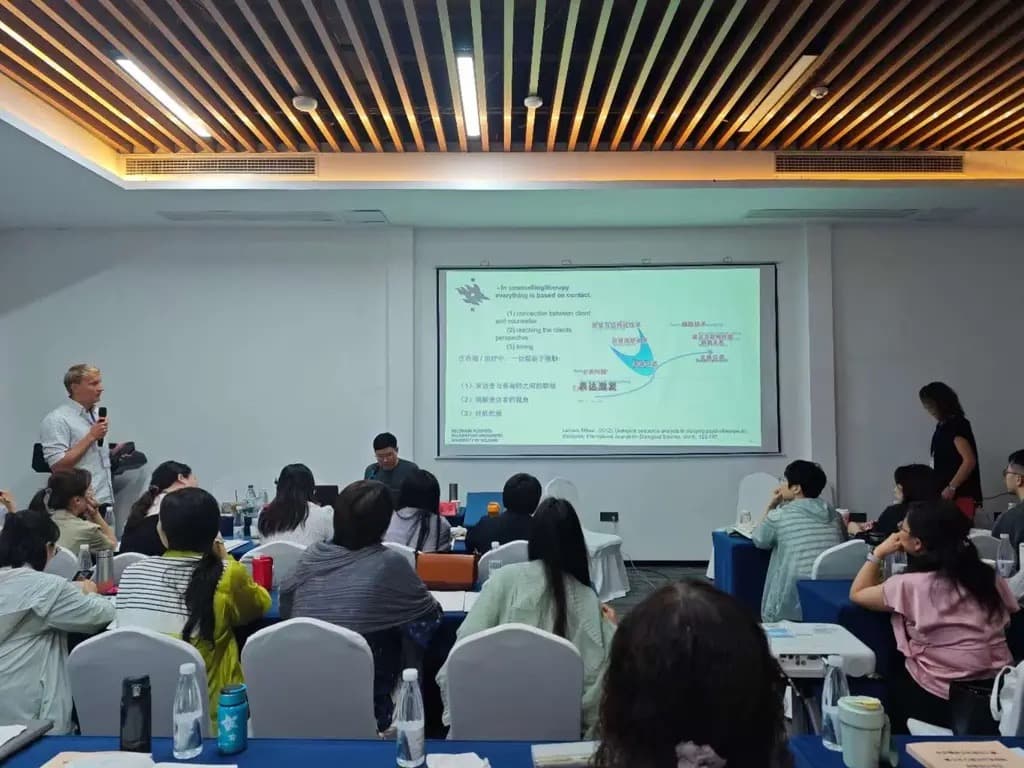
Översiktspresentationer om DSA, DiaSek och dialogisk handledning
Valkonen, H. (2015). Dialoginen sekvenssianalyysi ilmaisujen tutkimisen mikroanalyyttisenä menetelmänä — perusteita ja tutkimustuloksia.
I Toimijuuden tuki: dialoginen ohjaus (s. 105). Östra Finlands universitet.
Teoretisk forskning och teoriutveckling
Leiman, M. (2024). Semiotic object relations theory (SORT) as the basic CAT theory.
I Brummer, L. & Cavieres, M. & Tan, R. (Ed.) The Oxford Handbook of Cognitive Analytic Therapy. Oxford University Press.
Dias Neto, D. & Leiman, M. (2021). Two levels of meaning elaboration in psychological research.
Theory & Psychology, 31, 446–450.
Leiman, M. (2012). Dialogical sequence analysis in studying psychotherapeutic discourse.
International Journal for Dialogical Science, 6(1), 123–147.
Leiman, M. (2004). Dialogical Sequence Analysis.
I Hermans, H.J.M. & Dimaggio, G. (Eds.) The Dialogical Self in Psychotherapy. Brunner-Routledge, s. 255–269.
Leiman, M. (2002). Toward semiotic dialogism: The role of sign-mediation in the dialogical self.
Theory & Psychology, 12, 221–235.
Leiman, M. & Stiles, W. (2001). Dialogical sequence analysis and the zone of proximal development as conceptual enhancements to the assimilation model: The case of Jan revisited.
Psychotherapy Research, 11(3), 311–330.
Leiman, M. (1997). Procedures as dialogical sequences: A revised version of the fundamental concept in Cognitive Analytic Therapy.
British Journal of Medical Psychology, 70, 193–207.
Leiman, M. (1994). Projective identification as early joint action sequences: A Vygotskian addendum to the Procedural Sequence Object Relations Model.
British Journal of Medical Psychology, 67, 97–106.
Leiman, M. (1992). The concept of sign in the work of Vygotsky, Winnicott and Bakhtin: Further integration of object relations theory and activity theory.
British Journal of Medical Psychology, 65, 209–221.
DSA som metod i forskning om psykoterapeutisk förändring
Tikkanen, S. (2025). Lapsen tutkimusprosessi muutostapahtumana vanhemman kannalta.
Psykologia, 51, 58–63.
Savolainen, J., Lindfors, O. & Leiman, M. (2023). Individual target problems, self-observation and change in short-term psychodynamic psychotherapy.
Journal of Contemporary Psychotherapy, 54, 1–9.
Valkonen, H. (2019). Epävakaiden potilaiden itsehavainnoinnin laatu (Lectio Praecursoria).
Valkonen, H. (2018). The dynamics of self-observation in patients with borderline personality disorder (BPD) diagnosis.
Gersh, E., Leiman, M., Hulbert, C., McCutcheon, L., Burke, E., Valkonen, H., Tikkanen, S. & Chanen, A. (2017). Alliance rupture and repair processes in borderline personality disorder: A case study using dialogical sequence analysis.
Counselling Psychology Quarterly, 31.
Gersh, E., Hulbert, C., Leiman, M., McCutcheon, L., Burke, E., Valkonen, H., Tikkanen, S. & Chanen, A. (2017). The relationship between formulation, self-observation and the alliance process in psychotherapy for BPD.
International Journal of Cognitive Analytic Therapy and Relational Mental Health, 1, 71–98.
Tikkanen, S. (2015). Development of an empathic stance: Dialogical sequence analysis of a single case during child neurological assessment procedures.
Tikkanen, S. (2015). Katsaus kognitiivis-analyyttisesta psykoterapiasta tehtyyn tutkimukseen.
Zonzi, A., Barkham, M., Hardy, G., Llewelyn, S., Stiles, W. & Leiman, M. (2014). Zone of proximal development (ZPD) as an ability to play in psychotherapy.
Psychology and Psychotherapy, 87.
Tikkanen, S. & Leiman, M. (2014). Resolution of an impasse at a network meeting — Dialogical sequence analysis of the use of a shared formulation.
Counselling Psychology Quarterly, 27, 154–173.
Tikkanen, S., Stiles, W. & Leiman, M. (2013). Achieving an empathic stance: Dialogical sequence analysis of a change episode.
Psychotherapy Research, 23.
Leiman, M. (2011). Mikhail Bakhtin's contribution to psychotherapy research.
Culture & Psychology, 17(4), 441–461.
Tikkanen, S., Stiles, W. & Leiman, M. (2011). Parent development in clinical child neurological assessment process: Encounters with the assimilation model.
Psychotherapy Research, 21, 593–607.
Stiles, W., Leiman, M., Shapiro, D., Hardy, G., Barkham, M., Detert, N. & Llewelyn, S. (2006). What does the first exchange tell? Dialogical sequence analysis and assimilation in very brief therapy.
Psychotherapy Research, 16, 408–421.
DSA som terapeutens verktyg
Kivikkokangas, S. & Enckell, H. (2020). DSA psykoterapeutin työvälineenä.
Psykoterapia-lehti.
DSA i handledning
Leiman, M. (2015). DSA in supervision.
Speciella tillämpningar av DSA
Kaunisto, S.-L., Estola, E. & Leiman, M. (2013). 'I've let myself get tired' — one teacher's self-reflection process in a peer group.
Reflective Practice, 14.
Forskning och presentationer rapporterade i Finland och internationellt
Kivikkokangas, S. & Leiman, M. (kommande). Dialoginen sekvenssianalyysi — kliinisen kuuntelemisen menetelmä.
Vastapaino.
Savander, E. (2019). Implementation of dialogical sequence analysis as a case formulation for the assessment of patients at a community mental health centre: Randomized controlled pilot study.
Savander, E., Weiste, E., Hintikka, J., Leiman, M., Valkeapää, T., Heinonen, E. & Peräkylä, A. (2019). Offering patients opportunities to reveal their subjective experiences in psychiatric assessment interviews.
Patient Education and Counseling, 102.
Savolainen, J.S. (2017). Yksilölliset kohdeongelmat ja muutos lyhytpsykoterapiassa: Dialoginen sekvenssianalyysi muutoksen arvioinnissa.
Pro gradu. Helsingfors universitet.
Tikkanen, S. (2014). Formulation during the child assessment process.
Reformulation — Theory and Practice in Cognitive Analytic Therapy. Summer 2014.
Lahti-Nuuttila, P. (2011). Dialoginen sekvenssianalyysi (DSA) päiväsairaalapotilaan muutoksen arvioinnissa.
Licentiatavhandling, psykologi, Helsingfors universitet.
Leiman, M. (2011). CAT as integrative therapy.
4th International CAT Conference, Kraków, Poland.
Savolainen, J. (2011). Changes in observer position during short-term cognitive analytic group.
Poster, 4th International CAT Conference, Cracow, Poland.
Tikkanen, S. (2011). Using case formulation by DSA in analysing parent development — a case description.
Paper, 4th International CAT Conference, Cracow, Poland.
Torppa, M., Timonen, O., Keinänen-Kiukaanniemi, S., Larivaara, P. & Leiman, M. (2006). Patient-nurse-doctor interaction in general practice teleconsultations.
Journal of Telemedicine and Telecare, 12, 306–310.
Texter
På denna sida finns länkar till texter och studier som presenterar innehållet och utvecklingen av dialogisk sekvensanalys. Sidan uppdateras gradvis, med några månaders mellanrum.